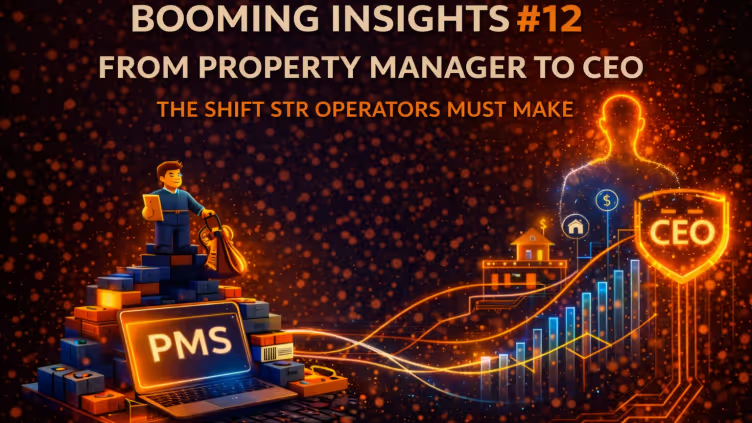
There’s a quiet problem in short-term rentals. We still describe what we do as “property management.” And that language is shaping how we think.
I remember sitting at dinner with my wife and family while building DesignedVR. My phone was under the table. A guest message came in. Then another. I believed — genuinely — that if I didn’t respond within five minutes, the business would break.
So I answered between bites of food. That was the reality of being the safety net.
If you believe your job is to manage properties, you focus on listings. Calendars. Cleaners. Messages. Turnovers. You measure responsiveness. You chase five-star reviews. You make sure nothing slips through the cracks — because you are the thing catching them.
That mindset built this industry. But it won’t carry it forward. Because the moment you move beyond a handful of units, you’re not just managing homes. You’re running a financial operation. You’re coordinating distributed teams. You’re balancing owner expectations, regulatory exposure, tax complexity, cash flow timing, and brand consistency — all at once.
That’s not property management. That’s business management. And the industry hasn’t fully caught up to that reality.
Why Great Operators Still Struggle as They Grow
Most operators don’t struggle because they lack hustle. They struggle because they scale the wrong thing. They scale activity — more bookings, more guests, more properties, more messages, more staff. But they don’t scale structure, so growth feels heavier instead of lighter.
When a guest books, it’s not just a reservation. It’s revenue allocation, tax handling, trust accounting, workload impact, owner reporting, and margin per stay. When a guest checks out, it’s not just a cleaner dispatch. It’s damage reconciliation, payout timing, maintenance forecasting, and performance data that shapes future decisions.
Each stay touches the entire business. Yet too many operators are still managing each stay like a standalone event. That’s the gap.
And when you are the one stitching it all together — answering messages, approving payouts, checking reports at midnight — growth becomes personal pressure. You become the glue. But glue doesn’t scale.
Properties Are Assets. The Business Is the System.
Properties are assets inside a business. The business is the system that turns bookings into profit.
It’s the structure that ensures payouts are accurate. It’s the architecture that protects margin when ADR softens. It’s the financial logic that connects operations to cash flow and growth decisions.
Many operators are already running sophisticated businesses — reconciling multi-channel payments, managing trust accounts, forecasting revenue, handling payroll, navigating compliance, protecting brand reputation.
That’s not small-scale coordination. That’s enterprise responsibility. And once you see that clearly, your expectations change.
Rethinking What Leadership Actually Means
This is where the shift becomes uncomfortable. Because the real evolution isn’t technological. It’s psychological.
Stop seeing yourself as an operator of units. Start seeing yourself as a CEO.
Stop reacting. Start designing.
Stop scaling activity. Start scaling architecture.
Stop measuring occupancy alone. Start measuring margin, resilience, and leverage.
The industry rewarded hustle. It rewarded the operator who answered every message, caught every mistake, approved every payout, solved every problem personally. You became indispensable. But indispensability is not scalability.
You cannot scale if every decision routes through you. You cannot scale if growth simply increases your oversight burden. At some point, you have to make the harder shift.
At some point, you have to step out of the inbox. Move from hero to architect. Delegate control. Let systems execute. Trust infrastructure. Stop being the safety net. Build something that doesn’t need one.
Rethinking What Your Core System Should Be
When you truly adopt that leadership posture, your expectations of systems naturally evolve.
You stop asking, “Does it sync channels?” You start asking, “Does it understand my business?”
Does it reconcile payments automatically and correctly, without manual patchwork at month end? Does it connect bookings to payouts to owner statements to real-time cash visibility? Does it understand that maintenance isn’t just a task, but a financial and reputational variable? Does it see operations, finance, and guest experience as one continuous system instead of isolated dashboards?
And most importantly — can it think with you?
Can you ask:
- Where are we leaking margin this month?
- Which properties are structurally underperforming?
- What happens to our cash flow if ADR drops by 8%?
- If we onboard 20 more units, where will pressure show first?
Not by exporting reports or stitching spreadsheets together. But by asking — and receiving context-aware answers rooted in live operational data.
That’s the difference between managing assets and operating a company.
Why We Built BAM
When I was answering those messages under the table, the real problem wasn’t the guest. It was the absence of infrastructure.
There was no execution layer inside the business that could hold context, make decisions, and move workflows forward without me.
That’s why we built BAM. Not as another feature. Not as a smarter chatbot. But as an operator inside the system — one that understands bookings, accounting, tasks, guest history, policies, and performance. One that doesn’t just assist, but executes.
Because once you see your company as a business — not a bundle of properties — you realize what’s missing isn’t more dashboards. It’s operational intelligence that acts. The kind that allows you to scale without carrying everything yourself.
The Industry Is Maturing. The Mindset Must Too.
Short-term rentals are no longer a scrappy side-hustle category. They are sophisticated hospitality businesses operating in a tightening market. You can keep thinking in properties — and feel the weight increase with every new unit. Or you can think in businesses — and build infrastructure that makes growth controlled, intentional, and sustainable.
That shift in thinking is exactly why the industry is beginning to move beyond traditional property management systems and toward what we call Business-as-a-Software.
Because this industry is no longer about managing properties. It’s about building businesses. And the operators who embrace that reality won’t just scale bigger. They’ll scale stronger.