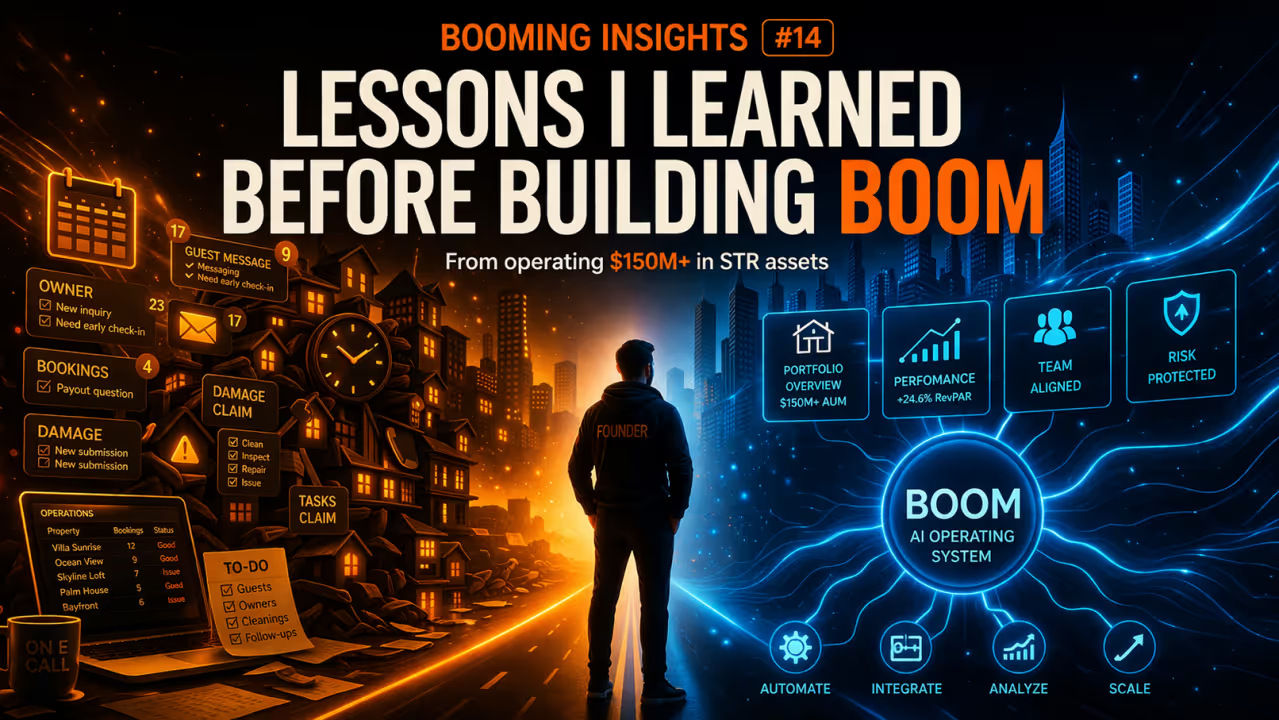
I didn’t get into this industry because I had a grand thesis about property management.
I got into it because a friend had a house sitting empty. We tested it as a short-term rental, and demand was immediate. So we added another. Then another. At some point, without really planning it, I wasn’t testing anything anymore — I was running a property management business.
I also didn’t come into this from a hospitality background. I came at it from a returns perspective. When I saw the potential in short-term rentals — the ability to drive yield in a way that didn’t exist in traditional real estate — that’s what pulled me in.
Over time, that grew into a business managing more than $150 million in vacation rental assets.
What matters to me now is not the clean version of that story. It’s what I learned while living inside it.
DesignedVR was a real business, with real scale, real guests, real owners, and real pressure. And what I learned is that most property managers are not held back by a lack of ambition. They are held back by lessons you only learn once the business is already heavy.
Those lessons are what eventually led me to build Boom.
1. Growth is not the hard part. Carrying growth is.
One of the first things I learned is that growth hides its own cost.
In the beginning, adding homes feels like progress. The portfolio grows, the team grows, revenue grows. From the outside, it looks like you are building momentum.
But inside the business, every new property adds another owner relationship, another set of expectations, another calendar, another opportunity for something small to go wrong. What looks like scale from the outside often feels like more plates spinning on the inside. That is true whether you manage 20 homes or 200.
For a long time, I thought the biggest challenge was getting to scale. It isn’t.
The real challenge is what happens once you get there. You spend less time building and more time checking, confirming, following up, and making sure nothing slips. You wear too many hats, stay constantly on call, and the business starts to rely on your awareness to keep it together.
That is not a temporary phase. That is what the business becomes unless something changes.
2. “Doing more” can quietly make the business worse.
As DesignedVR grew, I kept expanding around the core business.
We were not just managing homes. We got into construction, design, cleaning. On the investment side, I was raising and deploying capital.
At the time, all of it made sense. If something affects performance, control it. If something is inconsistent, bring it in-house.
That same mindset showed up in how we operated early on. We moved quickly, testing demand before fully committing — even something as simple as virtually furnishing a property, listing it, and seeing how it performed before making a real investment.
That speed was a big part of why we grew. But it also meant we got used to building on momentum — making decisions quickly, without always stepping back to think about how those decisions would compound as the business scaled.
But what I did not understand then is how much energy gets diluted when you are trying to do too many things at once. Not just operationally — but as a leader.
You are in more conversations. You are making more decisions. You are context-switching constantly. And even if everything is still working, you are no longer giving any one part of the business the attention it actually needs.
I only really understood this later: it is better to focus than to be spread. Not because growth is bad — but because every new layer you add doesn’t just give you more opportunity.
It gives you more to coordinate, more to oversee, and more that depends on everything else working properly.
And it forces you to ask a harder question: what kind of company are you actually building?
If that’s not defined, you don’t just grow — you accumulate friction. And over time, that friction turns into weight.
And that applies to any operator. You do not need to build multiple companies to feel this. You just need to keep adding — services, tools, people — without asking whether each new layer is making the business stronger, or just heavier.
3. A business can still look successful while losing its edge.
This is something I did not expect.
You can build a business that looks strong from the outside — strong portfolio, strong demand, a good team — and still feel like it is not operating the way it should.
I found myself in that position. I was effectively running multiple businesses at once. And over time, I could feel something changing inside the company. The spirit of the creation. The level of care. The sense of being an innovator. Nothing had collapsed. But it was not as sharp as it used to be.
That is a difficult place to be as a founder, because it does not show up clearly in metrics. But you feel it in how the business operates every day.
And that is when I understood something important: A business does not have to be failing to be drifting. And if you are building in this space, that is something you need to actively watch for.
Not just in your numbers — but in how your business feels to run. Are you still improving things, or just maintaining them? Is your team thinking, or just executing? Are you building, or mostly reacting?
Because if you don’t catch that shift early, the business doesn’t break. It just slowly becomes harder, slower, and less intentional.
4. Small operational decisions are not small when they repeat thousands of times.
One of the most concrete lessons I learned was around damage waivers. I did not implement them early enough.
At the time, it did not feel like a major decision. It was not strategic or urgent. But it repeated. Across every stay. Every guest. Every month. Over time, that added up to more than a million dollars.
That changed how I think about this business. A lot of profitability in property management is not decided by big moves.
Margin is not only won through headline decisions like pricing strategy or market expansion. It is decided in the quieter parts of the operation. How you structure fees. How you handle risk. How consistent your processes are. How clearly things are tracked and reported.
This is a business full of repetitive work, and if something inside that system is weak or delayed, it does not stay small. It compounds. Quietly. And by the time you notice it, it has already had a real impact.
The same applies to investment decisions. When things are working, it’s easy to make decisions based on what’s in front of you — what looks good in the moment. But building something durable requires a longer view. Not every opportunity you can take is one you should.
5. The real product of a property management business is clarity.
The biggest lesson underneath everything else is this.
At the beginning, it feels like a hospitality business. Then it starts to feel like an operations business. But once you have lived inside it at scale, you realize it is something else.
It is a business that depends on clarity. Clarity on what is happening. Clarity on what has been done. Clarity on what needs to happen next. Clarity on who is responsible. And whether those things are connected without constant human intervention.
Because when that clarity is not there, everything becomes heavier. The team feels it. The guests feel it. You feel it. Even if the business is still growing.
Why we built Boom
Boom didn’t start as an idea. It came from running a business where things worked — but took too much effort to keep working.
We had good people. We had tools. We had a strong operation. But everything was fragmented.
Information lived in different places. Work moved across disconnected systems. And visibility depended on asking, checking, following up. At some point, that becomes the job.
And that’s when I realized the problem wasn’t any single tool. It was the absence of a system that actually reflects how the business runs.
Something that gives you clarity without constant effort. That removes the need to ask, check, and chase.
That’s what we wanted to build. That’s what became Boom.
Final word
If I strip all of this back, the reason we built Boom is simple.
I had already lived the operator journey far enough to know that the biggest constraint in this industry is not demand. It is not even competition. It is the amount of human effort it takes to keep a growing business running.
DesignedVR showed me what success actually feels like from the inside: not just the upside, but the weight, the fragmentation, the responsibility to teams and families, and the creeping realization that great people still struggle when the system around them is not built for scale.
Looking back, none of these lessons came from big mistakes. They came from things that felt right at the time. Growing. Expanding. Improving.
Only later do you realize what those decisions created underneath.
That’s what DesignedVR gave me. Not just a successful business — but a clear understanding of what it actually takes to run one at scale.
Boom came from that. Not from theory, but from experience.