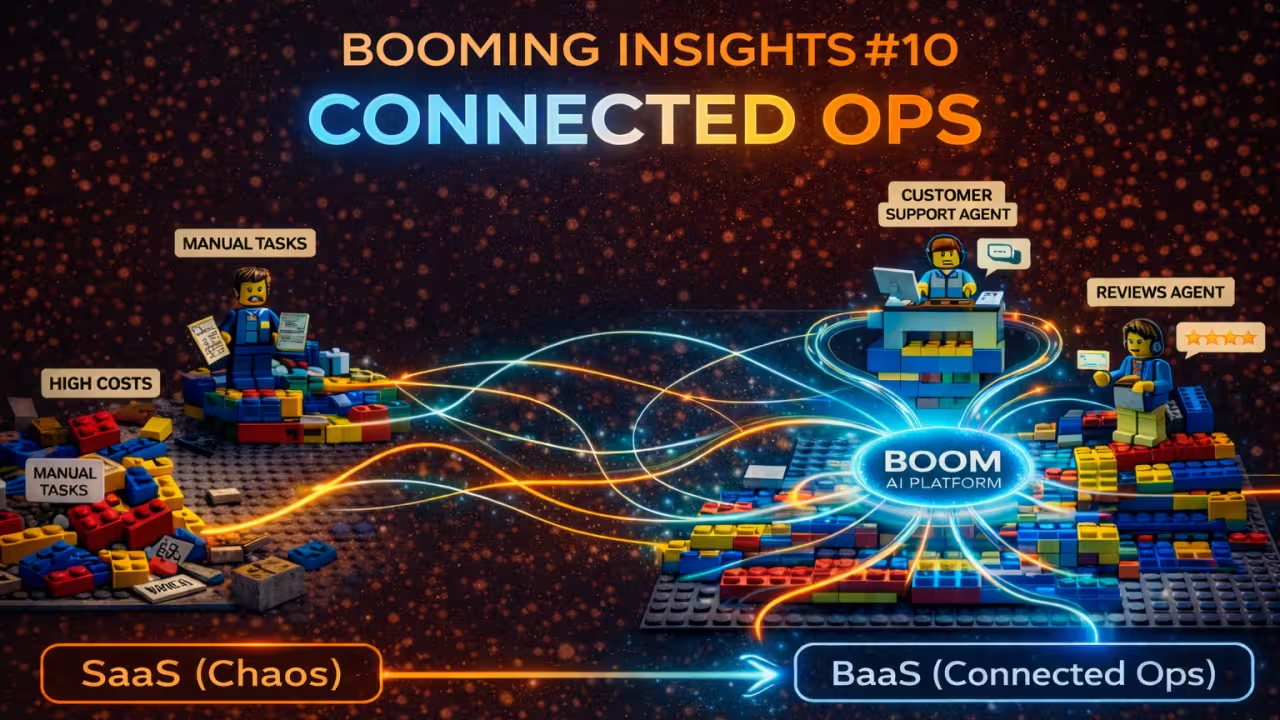
If you run a short-term rental business, your journey probably started like most: you picked a PMS. Then, as your business grew, you added more tools to fill the gaps — messaging, task management, dynamic pricing, guest apps, dashboards, review responders, owner reporting.
Each tool was solving something. But slowly, something strange happened.
You found yourself spending more time managing the software than managing the business.
You weren’t running your operation through software. You were managing your software just to keep the operation alive.
And the problem wasn’t the tools. It was the foundation they were built on.
The PMS was never built to run a business
The PMS was built for reservations—not for running a business
The original Property Management Systems were designed in a very different era.
Early PMS platforms existed for one reason: to store reservations and sync calendars.
They weren’t built to manage operations. They weren’t built to coordinate teams. They weren’t built to execute workflows. They certainly weren’t built to scale modern, multi-market businesses.
That limitation wasn’t a failure—it was a reflection of the time. But most PMS platforms today are still anchored to that same core logic.
Some haven’t changed at all. Others have layered features on top. A few have added “AI.” And that’s where the confusion starts.
Most PMS platforms either have no AI whatsoever, or they rely on bolt-on AI tools—chatbots, auto-replies, summaries, or reports sitting outside the system of record.
Even when AI is present, the operating model is unchanged:
- A human clicks.
- The system responds.
- A guest asks a question, a bot replies.
- A report runs, someone interprets it.
- A human decides what to do next.
This is not intelligence that runs a business. It’s intelligence that waits.
It doesn’t understand how the operation works. It doesn’t know priorities, tradeoffs, or consequences. It can’t make decisions. And it can’t take responsibility for outcomes.
That’s not execution. That’s assistance. And assistance—no matter how polished—doesn’t change the fundamentals.
Which is why we didn’t try to modernize PMS. We replaced the model entirely.
BaaS: A new category for how modern businesses run
We call it Business-as-a-Software, or BaaS.
Where traditional SaaS helps humans complete tasks, BaaS systems hold the business logic themselves. They understand what needs to happen, when, and why — and then execute, end to end.
This isn’t about layering AI on top of legacy systems. It’s about creating a platform that holds operational logic, makes decisions, and takes action — across departments, functions, and workflows.
In a BaaS model, you don’t log into multiple tools, click through dashboards, or toggle between platforms to keep things moving. You tell the system what outcome you want — and it runs the workflows to make it happen.
It understands your rules. It remembers context. It learns. And it gets better over time.
BAM: The business brain inside Boom
At the center of Boom is BAM — our Business Agentic Manager, and the core of how BaaS becomes real.
BAM isn’t a chatbot or bolt-on. It’s not there to assist a human operator. BAM is the operator.
It understands how your business works — your SOPs, preferences, policies, and edge cases. And then it acts:
- A guest asks for early check-in? BAM checks cleaning schedules, booking buffers, and unit availability, and confirms or declines.
- A toilet leaks? BAM dispatches the right vendor, updates the task log, informs the guest, and pushes the expense to the P&L.
- A team member is overloaded? BAM reallocates the workflow based on current capacity and performance history — automatically.
This isn’t task automation. This is the automation of execution.
BAM isn’t sitting on top of your data. It’s inside the system. It sees what’s happening in real time and acts accordingly — just like your best team member would. Only faster. And without burnout.
More headcount doesn’t scale operations. Strong systems do.
Here’s an uncomfortable truth the industry rarely says out loud:
The more people a business adds, the more complex and inefficient it often becomes.
You don’t scale by growing headcount. You scale by removing the operational weight that makes growth hard.
BAM gives operators real leverage — not by making teams faster, but by reducing how much they need to touch at all. It’s the infrastructure shift that allows teams to do more with less, and leaders to focus on what actually grows the business: expansion, relationships, strategy, and brand.
This isn’t about managing complexity. It’s about eliminating it.
The infrastructure era is here
What you build now matters more than ever.
The system you’re on today will determine what you can scale tomorrow — and how easily you’ll break when you try. PMS was a useful start. But this industry has moved beyond property management.
Operators are now running distributed businesses, managing guest experience, finance, compliance, team coordination, investor reporting, and multi-market growth. That’s not a PMS problem. That’s a systems problem.
And that’s what Boom solves.
We’re not here to help you manage the work.
We’re here to run it.
This is the shift from assistance to execution. From stacks to systems. From dashboards to outcomes. From human-driven coordination to AI-powered operations.
BAM is the business brain. Boom is the system that runs the business. And this is what comes next.